The Angelus: Our Newsletter
Volume 22, Number 37
Clothing Ministry: Marie Rosseels, José Vidal, and Brother Damien Joseph organized and managed our first “Drop-By” at the Forty-seventh Street entrance of the church on Wednesday afternoon, August 5. Read more below.
Photo: José Vidal
FROM THE RECTOR: ANCIENT HUMAN TRAFFICKING
Most of my life as an Episcopalian has been lived in Rite Two. But there are days when I wish a few things were different. We are in the period in the year when God’s love and mercy don’t seem to be very much in evidence in many of the stories we read from the Old Testament at Daily Morning and Evening Prayer. This liturgical year, on Saturday morning, July 11, we heard the account of Moses’ death (Deuteronomy 34:1–12). God did not forgive him. Moses died, having seen, but not entered, the Promised Land. That night at Evening Prayer, David slew Goliath (1 Samuel 17:31–49). Following Moses’ death, Joshua led the children of Israel into the conquest of the Promised Land with the slaughter of men, women, children, and cattle.
Father Jay Smith was celebrant and preacher on the Ninth Sunday after Pentecost, August 2, 2020.
Photo: Damien Joseph SSF
Last Sunday at Morning Prayer, we heard the conclusion of Jericho’s fall and the slaughter of “men and women, young and old, oxen, sheep, and asses, with the edge of the sword” (Judges 6:21). Rahab the harlot, who hid the Hebrew spies and helped them escape, and her family and household alone were “saved alive” (Judges 6:25). At Evening Prayer, Saul had gone after David to kill him (1 Samuel 7–18).
As I write on Saturday, August 8, Gideon’s son Abimelech, who had seventy of his seventy-one brothers killed so that he could succeed his father, was himself killed in battle. Last night at Evening Prayer, the prophet Nathan confronted David for having Uriah the Hittite murdered so that he could Uriah’s wife, Bathsheba as his wife (2 Samuel 12:1–14). Tonight, I know we will hear the fulfillment of the last words of that lesson. Nathan said to David, “The Lord also has put away your sin; you shall not die. Nevertheless, because by this deed you have utterly scorned the Lord, the child that is born to you shall die” (2 Samuel 13b–14).
This Sunday morning, August 9, the story of Jephthah’s daughter (Judges 11:1–11, 29–40) is appointed. Professor Phyllis Trible in her book, Texts of Terror: Literary-Feminist Readings of Biblical Narratives (1984), calls this episode, “The Daughter of Jephthah: An Inhuman Sacrifice” (93–116). Page 117 of this book is entitled “In Memoriam.” Trible lists her chapters in reverse order, “The Daughter of Jephthah, An Unnamed Woman, Tamar, Hagar.” It just so happens we have another text of terror tomorrow at Evening Prayer, the story of David’s son Amnon raping his sister Tamar (2 Samuel 13:1–22). Of course, Trible’s book doesn't include every Old Testament story that merits identification as a text of terror.
The Daily Office Lectionary omits the Unnamed Woman (Judges 19:1–30). It’s a story about real evil being done to a woman while she was alive and to her body when she was dead. I’m going to see if we can include it in our Daily Office lessons next week. If I can make it work, we will read Judges 18 on Tuesday, August 18, and Judges 19 on Wednesday. The next day we begin the Book of Job.
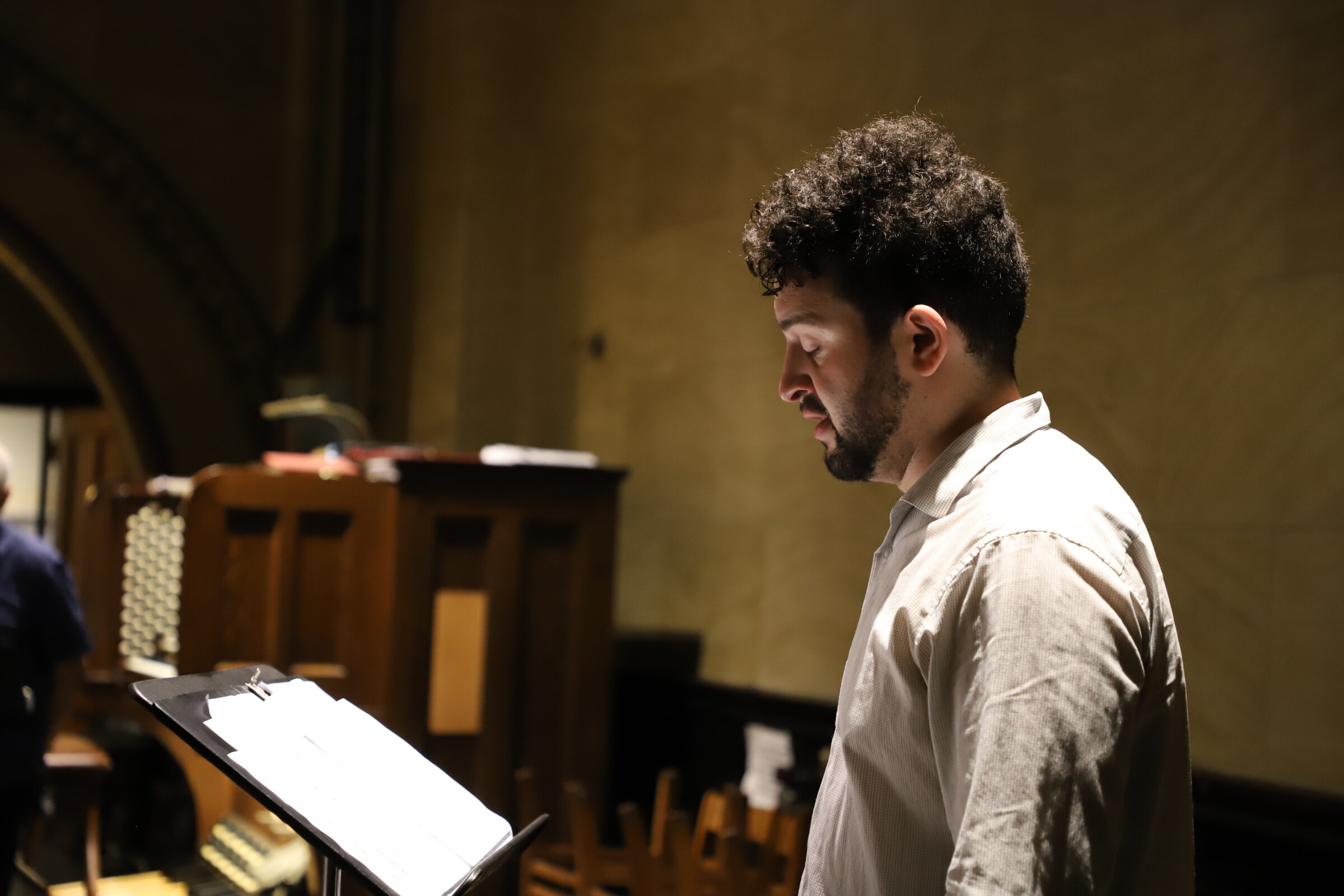
Daniel Castellanos was soloist.
Photo: Damien Joseph SSF
In the earlier Prayer Books, only two lessons were appointed for Eucharists. The first was called “the epistle.” After the reading, the minister said, “Here endeth the epistle” (The Book of Common Prayer [1928], 70). For the conclusion of the gospel, the 1928 Prayer Book provided, “And after the Gospel may be said, ‘Glory be to thee, O Christ’ ” (Ibid.) At Morning and Evening Prayer, the minister would conclude by saying, “Here endeth the First (or the Second) Lesson” (page 9).
With the 1979 Prayer Book, in Rite One, the traditional responses may be used—there are three options (page 325). In Rite Two, there are also three options. Invariably, after a reading, the reader may say, “The Word of the Lord,” and the congregation responds, “Thanks be to God.” “Here ends the Lesson (Reading)” may also be used with no response. To keep things simple, we invariably use “The Word of the Lord” and the response after all readings except the gospel at Mass. I think it’s worth the extra time it will take to read in memory of the Unnamed Woman. Human trafficking for sexual exploitation is still with us. —Stephen Gerth
YOUR PRAYERS ARE ASKED FOR Mary, Eric, Marley, Leroy, Seaudath, Larry, George, Stuart, Scott, Samantha, Michael, Emily, Shalim, John, Marilouise, Ken, May, Willard, Alexandra, Takeem, and Ethelyn; for John, Sean, and David, religious; for John, Gene, Gaylord, Louis, priests; and Charles, bishop; for the members of the armed forces on active duty, especially Isabelle; for all health-care workers; for all those who work for the common good; for the people of Beirut and all the people of Lebanon; for all the members and friends of this parish; and for the repose of the souls of Sydney Mehl, all those who have died of COVID-19, and all those who died in the explosion in Beirut this week . . . GRANT THEM PEACE: August 9: 1897 Mary Minturn Trask; 1905 William Reutcliffe; 1991 Blanche E. Preene.
THE ORDINARY FRIDAYS OF THE YEAR are observed by special acts of discipline and self-denial in commemoration of the Lord’s crucifixion.
STEWARDSHIP AT SAINT MARY’S . . . We expect that this year’s Stewardship Campaign will be both challenging but also, in many ways, helpful. The campaign must go on, despite the pandemic and its disruptive effects. Many of us have experienced the financial repercussions of this global medical emergency. This cannot help but make us cautious. Still, the crisis should also inspire us, now more than ever, to work hard to preserve what we value most. The Stewardship Committee met this week via Zoom and has begun planning for the 2020–2021 Campaign. Pledge packets will be mailed in October. We will work hard to inform the parish community of our hopes and plans as we move forward. In the meantime, we ask you to pray for the success of the campaign, and also to spend some time thinking, and praying, about what you can do to support the parish, and to ensure its future, through the gifts of your time, talents, and treasure this year and in the years to come.
CLOTHING MINISTRY, Wednesday, August 5, 2020.
Photo: José Vidal
AROUND THE PARISH . . . Clothing Ministry: Marie Rosseels, José Vidal, and Brother Damien Joseph organized and managed our first “Drop-By” at the Forty-seventh Street entrance of the church on Wednesday afternoon, August 5. In preparation for the event, bags with the Saint Mary’s logo printed on them, had been filled with toiletry articles and hung from the metal fence surrounding the porch. Then, in the vestibule of the entrance, tables with articles of clothing, as well as shoes and sneakers, had been set up and well organized. A rack of dresses, pants, and jackets was placed on the sidewalk, next to the entrance. Then José made a turn of the neighborhood and spoke to some of our neighbors who temporarily sheltering in hotels on Forty-sixth and Forty-seventh Streets, inviting them to “drop by.” The system worked, and the volunteers were able to distribute almost all of the toiletry articles and clothing set out for the day. They also learned that toiletry articles are particularly desirable, since neither the hotels nor the city are providing them. It was a good day: much-needed items went out the door, and we learned some things about the changing situation in the neighborhood . . . The leadership team of the Saint Mary’s Clothing Ministry met via Zoom on Thursday afternoon, August 6, to review the “Drop-By Day” and to discuss fundraising for the Clothing Ministry. If you would like to make a donation, please contact the parish office at 212-869-5830 or at info@stmvnyc.org . . . Brother Desmond Alban SSF was able to leave quarantine on Thursday, August 6, and has now moved into the fifth-floor apartment of the Parish House. He will be sharing the space, of course, with Brother Damien Joseph SSF and Brother Thomas SSF. They are planning to configure the two spaces—one in the Mission House and one in the Parish House—to facilitate their community life. We are very happy that Brother Desmond is healthy and well and that he is now here at Saint Mary’s. He has already been participating in weekly staff meetings, racism discussions, and meetings of the clothing ministry. Brother Damien and Brother Thomas helped with the move into the fifth-floor apartment. We are especially grateful to sextons, Harka Gurung and Jorge Trujillo, who made many trips up to the fifth floor and back again on a hot August day in order to accomplish the move. Thank you to all and welcome, Brother Desmond! . . .There are currently two groups—around ten people in all—who are meeting weekly via Zoom to discuss racism and to try to discern ways to combat racism in both church and society. If you would like more information, or if you would like to participate, please contact Brother Thomas SSF or Brother Damien Joseph SSF . . . Many members and friends of Saint Mary’s will have read by now of the Turkish government’s decision to convert the Hagia Sophia in Istanbul into a mosque. Hagia Sophia was built as the cathedral church of the patriarch of Constantinople in 537 CE. It is one of the oldest surviving church buildings in the world. It is still studied for what it can tell us about the early Byzantine liturgy and the theology and religious practices of the non-Latin Christian world. Hagia Sophia is still revered by many as an ancient Christian holy site. When the Ottoman Turks conquered Constantinople in 1453, they converted the church into a mosque. When the Ottoman Empire fell, and the secular republic of Turkey was formed in the 1920s, the Turkish government turned Hagia Sophia into a museum, which secular, “non-denominational” purpose it served until the Turkish government’s recent decision. That decision has been deplored by many Christian leaders, including the Archbishop of Canterbury, whose statement may be read here. Though Christians have also been known to turn mosques into churches, for example in medieval Spain during the Reconquista, one had hoped that contemporary world leaders had grown more sensitive to the delicate issues involved in making such moves. One hopes that the Turkish government will reconsider its decision. In the meantime, let this be a teachable moment during which Western Christians take the time to learn more about Eastern Orthodoxy and its traditions, and let us pray for peace and understanding among the faithful people of all the world’s religions.
MUSIC AT SAINT MARY’S . . . The musical setting of the Mass on Sunday is Mass I as found in the Liber Usualis (Usual Book), a comprehensive anthology of medieval Roman plainsong compiled in the nineteenth century by the monks of Solesmes, France. Like the several other numbered Masses of the Gregorian Missal, Mass I, subtitled Lux et origo (Light and Source), is a collection of chants for the Ordinary of the Mass which likely were originally independent pieces brought together and associated with one another only by later custom. This particular combination was traditionally sung in the Easter season. All parts of Mass I are thought to date from the tenth century. Gloria, Sanctus, and Agnus Dei from this setting will be sung by the cantor, all of which are in the fourth mode.
Board Member Leroy Sharer was crucifer and reader for the Mass.
Photo: Damien Joseph SSF
The cantor at Mass on Sunday is Christopher Howatt, Parish Administrator at Saint Mary’s and tenor in the choir. During the ministration of Communion, he will sing A Simple Song from Mass (1971) by Leonard Bernstein (1918–1990). Bernstein, a giant of American twentieth-century musical life, called the piece “Hymn and Psalm: A Simple Song.” The text consists of verses taken from a number of psalms, which have been adapted and woven together by the composer in collaboration with Stephen Schwartz (b.1948). Chris Howatt has been a regular member of the Choir at the Church of St. Mary the Virgin for more than 10 years and stepped into the role of Office Manager at the Church nearly five years ago. Not only is he an actively performing singer in the realms of musical theatre and cabaret, he was a member of the Associate Chorus of the Metropolitan Opera for two seasons. He has been heard on recordings as diverse as Jessye Norman’s Christmas CD In the Spirit, to singing backup for The Pet Shop Boys on their cover of the Village People’s “Go West.” As an accompanist and music director he has worked with such talents as David Hyde Pierce, Howard McGillin, Tyne Daly, Rita Moreno, Brad Oscar and Cady Huffman and others. He has served as musical supervisor for productions of Sylvia, Lend Me a Tenor and Inspecting Carol at George Street Playhouse as well as musical director for their world premiere production of Come Back, Come Back, Wherever You Are, written and directed by the late theatrical legend Arthur Laurents. For several years he displayed both pianistic and vocal talents as music director/arranger and performer with the two-time MAC Award nominated vocal group Boulevard East, producing and recording their CD, Timeless, as well as performing with them in various cabaret venues.
FROM THE FRIARY . . . Brother Desmond Alban SSF recently posted a meditation on the Society of Saint Francis website, entitled “Wealth at Home in Poverty: Reflections from Ancient Christian Wisdom.” Brother Desmond explains that while he was in quarantine for two weeks here in Manhattan, he spent some time reading the Gospel of Thomas, one of the so-called “apocryphal gospels,” and using it as a source for lectio divina. Brother Desmond shares some of his reflections here. Brother James Nathaniel SSF, who lives at San Damiano Friary in San Francisco, has posted a sermon that he delivered online recently, entitled “Compassion and Guts.” The sermon can be read on the Society’s website by following this link.
THIS WEEK AT SAINT MARY’S . . . Sunday, August 9, The Tenth Sunday after Pentecost, Mass 11:00 AM. The church opens at 10:00 AM and closes at 12:30 PM. The celebrant and preacher is Father Peter Powell . . . Monday through Saturday, the church opens at 11:00 AM and closes at 2:00 PM. Mass is celebrated daily at 12:10 PM. Please see the Calendar of the Week for this week’s commemorations.
SAINT MARY’S ONLINE CENTERING PRAYER GROUP . . . The Saint Mary’s Centering Prayer Group continues to meet! The Group meets online, via Zoom, every Friday evening at 7:00 PM. If you are interested in participating, please send an e-mail to this address. The convenors of the group will then send the link to the Zoom meeting.
THE FLOWER MARKET HAS REOPENED . . . We now welcome donations for flowers for the high altar. The suggested donation for those arrangements is $250.00. Please be in touch with Chris Howatt by email if you would like to make a donation.
AT THE MUSEUMS . . . Many members and friends of Saint Mary’s studied portions of the Book of Exodus with Father Peter Powell this spring. During the shutdown, Father Pete sent out eight exegetical papers, each of which included a set of study questions, concerning a number of key passages in Exodus. We thought of Father Powell’s online “classes” recently when we came upon an article entitled, Welcoming “Guests,” Old and New, at the Passover Seder: Elijah, Miriam, and an Orange: Discover the important role of women in the Passover story, as told through works from the Jewish Museum collection.The article, available via this link on medium.com (the website has a pay wall, but gives three free articles per month), features the work of several contemporary artists whose work is in the Jewish Museum’s permanent collection, including an “Elijah Chair,” by Melissa Shiff and a “Miriam Cup” by Amy Richert. Using these objects as examples, the article discusses contemporary interpretations of the Passover story. Of particular interest to the Saint Mary’s community is Shiff’s work. From the article, “The artist Melissa Shiff found inspiration in the custom of opening the door for the prophet Elijah during the Seder when she made Elijah Chair in 2002. Shiff expands this specific tradition to welcome people from all walks of life. A monitor embedded in the chair’s back displays a video loop of doors that open into various homes: uptown, downtown, rich, poor, and everything in between. ‘If Elijah represents hospitality,’ the artist explains, ‘I wanted to push his role even further and employ this prophetic figure in the service of social action.’ Shiff created this work as part of the Times Square Seder, a 2002 multimedia event of readings, performances, video projections, art installations, and a ‘Matzoh Ball Soup Kitchen’ for the homeless. Elijah Chair is a meditation on unconditional hospitality and the unequal distribution of wealth in urban America. At a time when we are advised to keep our doors physically closed due to the raging pandemic, Shiff’s opening of virtual doors could not be more timely; while we shelter in place, the artist reminds us of the many people who have no place to shelter.”—J.R.S.
Board Member Grace Mudd was thurifer. Incense was offered during Gloria in excelsis and the Great Thanksgiving.
Photo: Damien Joseph SSF
SOME GUIDELINES FOR ATTENDING SERVICES AT SAINT MARY’S:
We are now open for public worship. In order to ensure the health and safety of all, we have instituted the following procedures and guidelines:
- The 47th Street Doors, though open for ventilation, won’t be used for entry into the church. Entry is only via 46th Street.
- Exit only through the most western 46th Street door (near the former gift shop)
- The Mercy Chapel and Saint Joseph’s Chapel are closed.
- The Lady Chapel is open, but all chairs, cushions, candles, hymnals, and Prayer Books have been removed.
- Facemasks must be worn in the church at all times, except when receiving Communion. Masks should cover both mouth and nose.
- Hands-free sanitizer dispensers are available by the doors and at the head of the center aisle, where Communion will take place.
- The ushers will not take up a collection. A basket has been placed at the head of the main aisle, where pledge envelopes and other donations may be safely placed. There will be no offertory procession.
- The city, state, and diocese of New York encourages all those attending services to sign a registry and to provide one means of contact. This will be used only if it emerges that an infected person has been in attendance at a particular service and contact tracing is required.
- Everyone must maintain safe distancing (at least 6 feet apart).
- Pews have been marked with blue tape to indicate where seating is allowed
- Only 40 people will be allowed in the nave at any time (this includes 6 couples or pairs—people who live together—who may sit together.
- All cushions have been removed from the pews.
- All prayer books and hymnals have been removed from the church.
- Mass bulletins will be provided, but will be removed from the church after each service.
- Electric fans have been removed from the nave of the church.
- There will be no hand-held fans available at the door
- Communion (wafers only) will be ministered at the foot of the chancel steps.
- Gluten-free hosts are available. Please inform an usher or a member of the clergy.
- All communicants must proceed down the main aisle, maintain social distance as indicated by the decals on the floor, and return to their seats via the side aisles.
- There will be no congregational singing.
- Restrooms will be available only to those who are attending the service.
- There will be no coffee hour.
- These guidelines are to ensure the health and safety of all. Please follow the directions of the ushers and the members of the clergy. If you have questions or wish to make a suggestion, please contact the rector.
This edition of the Angelus was written and edited by Father Stephen Gerth and Father Jay Smith. Father Gerth is responsible for posting the newsletter on the parish website and for distributing it via e-mail.